Static Mixer (Inline Mixer)

Energy-Efficient Inline Mixing Solution Without Moving Parts

Verito’s Static Mixers are advanced, energy-efficient mixing solutions designed for continuous inline blending of fluids, gases, and multi-phase slurries—without any moving components.

Engineered for consistent performance, low maintenance, and high reliability, these mixers ensure homogeneous mixing, controlled reactions, and optimized process efficiency across multiple industries.

Widely used in water treatment, chemical processing, oil & gas, pharmaceuticals, and food processing applications.

Static Mixer

How a Static Mixer Works


  • A static mixer consists of fixed geometric elements installed inside a pipeline. As fluid flows through these elements:
  • The flow is continuously split, rotated, and recombined
  • Radial and axial mixing is achieved
  • Turbulence (or controlled laminar mixing) enhances uniformity
  • This results in high-efficiency mixing with minimal energy input, using only the pressure drop of the flowing fluid.


Design Parameters Considered

At Verito, every static mixer is custom designed based on:


  • Flow Rate (m³/hr)
  • Fluid Properties (Density, Viscosity, Non-Newtonian)
  • Reynolds Number (Laminar / Turbulent)
  • Mixing Objective (Blending / Reaction / Dispersion)
  • Pressure Drop Limitations
  • Pipe Size & Installation Constraints
  • Number of Elements & L/D Ratio


Technical Specifications


Line Size DN15 to DN1000+
Flow Rate As per process requirement
Pressure Rating Up to 150 bar
Temperature Up to 400°C
Material of Construction CS, SS304, SS316, Duplex, Alloy, PTFE, FRP
Mixing Efficiency Up to 99%+ homogeneity


Key Features & Advantages


  • No moving parts – Zero mechanical wear, minimal maintenance
  • Energy efficient – No external power required
  • Compact & Inline Design - Easy integration into existing pipelines
  • Uniform Mixing Quality - High degree of homogeneity
  • Low Operating Cost - Reduced lifecycle cost
  • Custom Engineered Designs - Tailored for specific process conditions
  • Wide Material Options - SS304, SS316, Duplex, PTFE, FRP, Alloy materials


Applications


  • Water Treatment: Chemical dosing, pH correction, Coagulation & flocculation enhancement
  • Chemical Industry: Acid dilution, Neutralization processes, Additive injection & blending
  • Oil & Gas: Corrosion inhibitor dosing, Additive injection, fuel blending
  • Food & Beverage: Syrup dilution, flavor blending, Dairy processing
  • Pharmaceutical & Specialty Chemicals: Precise reagent mixing, Continuous process blending
  • Mineral & Mining Industry: To Homogenise Slurries


CFD in Mixing Technology
What is CFD ?


  • Computational Fluid Dynamics (CFD) represents an approved approach within the realm of fluid mechanics. Its widespread application is evident in industries such as automotive, aircraft, process, and mixing.
  • The primary objective of CFD is to address fluid flow-related inquiries by leveraging numerical techniques. The governing equations typically revolve around principles like Navier-Stokes, Euler, or potential-based equations.


Flow Simulation at Verito


  • Verito leverages cutting-edge Computational Fluid Dynamics (CFD) technology, alongside laboratory experiments and field trials, to design, scale-up, enhance, or modernize agitators and mixing systems.
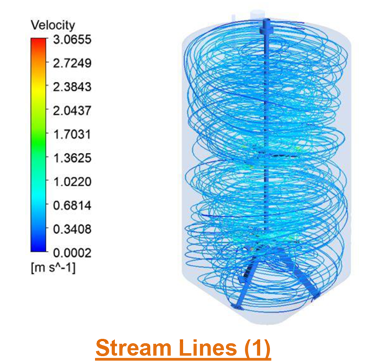
  • Verito’s engineers utilize CFD technology to gain an in-depth understanding of velocity distribution, flow patterns, areas with low velocity (referred to as dead zones, as illustrated in Figures 1, 2 & 3), as well as regions with both low and high shear rates within various mixing system configurations.
  • This enables the testing of multiple system setups and tank agitator designs to achieve optimal performance. Additionally, CFD technology aids Verito in fine-tuning impeller blade designs to strike a balance between power requirements and pumping capacity.


Key Outcomes of CFD-Studies


  • In-depth Information of Flow pattern
  • Areas with the potential of low mixing intensity can be pinpointed and rectified.
  • Availability of crucial process parameters like shear and energy dissipation
  • Evaluation of different design options
  • Shortened project timelines for complex process mixing systems
  • Mitigation of project risks