High Speed Agitators

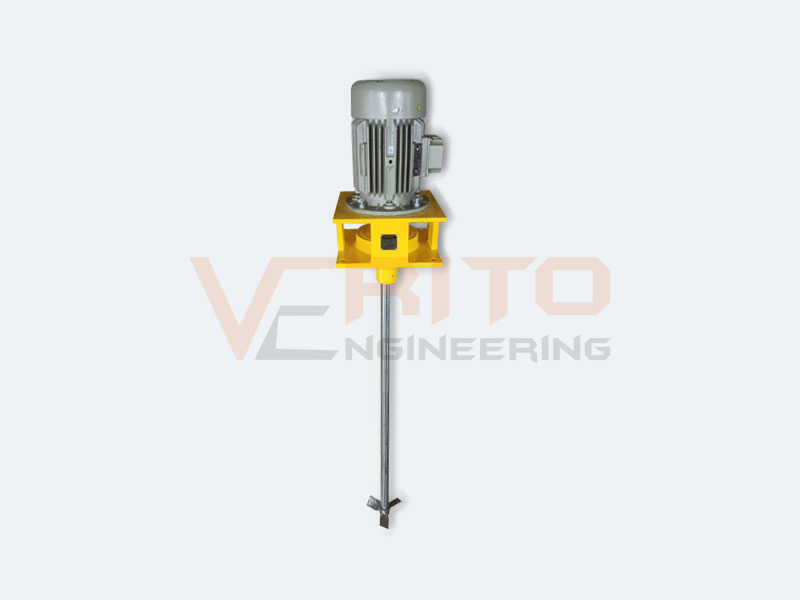
Verito’s direct driven Agitator type is an innovatively designed top flange agitator for use in the food and pharmaceutical industries. It is a mixer without gearbox, so there is no oil/lubricants leakage which could contaminate your product


The mixer shaft is directly fitted directly into the drive, eliminating the need for an extra shaft coupling. The High- Speed Agitator are a strong and practically maintenance-free mixer which makes it a perfect solution for applications in the food and pharmaceutical industry. It is suitable for frequency converter-controlled operation.


Key Technical Parameters


Motor Power 0.1-15 kW
Shaft Diameter 30-300 mm
Operating Pressure Vacuum – 200 bar
Impeller Type High Efficiency Impeller, Propeller, Hydrofoil, Alpha impeller, Turbine, Cowles Disk
Materials (Wetted Parts) MS, EN8, SS316, SS316L, CS, Duplex & Super Duplex Steel


Feature


  • Designed for efficient agitation at high speeds.
  • Allows precise control of agitation speed.
  • Small and space-efficient design for easy integration.
  • Capable of handling various mixing processes.
  • Quick and hassle-free installation process.
  • Requires minimal maintenance, reducing downtime and optimizing productivity.


Applications


High-Viscosity Mixing

  • Industrial high-speed agitators are used for mixing high-viscosity materials such as adhesives, polymers, and pastes.
  • They provide intense agitation and shear forces to achieve proper blending and dispersion.

Ink and Coating Production

  • Industrial high-speed agitators are employed in the production of inks, coatings, and paints.
  • They facilitate rapid dispersion and wetting of pigments, resins, and other components for consistent and high-quality formulations.

Homogenization

  • Industrial high-speed agitators are utilized for homogenizing liquid and semi-solid products.
  • They ensure uniform texture, particle size reduction, and product consistency.

High-Speed Fermentation

  • High-speed agitators are used in fermentation processes where rapid mixing and aeration are required.
  • They provide optimal conditions for microbial growth and metabolite production.

Pharmaceutical Manufacturing

  • High-speed agitators are employed in pharmaceutical manufacturing processes that require fast and efficient mixing, blending, and dissolution.
  • They assist in achieving uniform distribution of APIs and excipients.

Dispersing and Emulsifying

  • High-speed agitators find applications in dispersing and emulsifying processes where fine particle size reduction and stable emulsion formation are required.
  • They assist in achieving uniform distribution of additives, pigments, and fillers.

Chemical Reactor Mixing

  • High-speed agitators are used in chemical reactors for fast and efficient mixing of reactants.
  • They assist in achieving high conversion rates and minimizing reaction times.

Disintegration and Dissolution

  • High-speed agitators find applications in processes that require rapid disintegration and dissolution of solids into liquids.
  • They assist in achieving quick and efficient dissolution rates.

Cosmetic and Personal Care Products

  • Industrial high-speed agitators find applications in the production of cosmetics and personal care products such as creams, lotions, and gels.
  • They assist in achieving uniform dispersion of ingredients and stable emulsions.

Food and Beverage Processing

  • Industrial high-speed agitators are used in the food and beverage industry for processes like mixing, emulsifying, and dissolving ingredients.
  • They aid in achieving rapid and efficient production while maintaining product quality.
CFD in Mixing Technology
What is CFD ?


  • Computational Fluid Dynamics (CFD) represents an approved approach within the realm of fluid mechanics. Its widespread application is evident in industries such as automotive, aircraft, process, and mixing.
  • The primary objective of CFD is to address fluid flow-related inquiries by leveraging numerical techniques. The governing equations typically revolve around principles like Navier-Stokes, Euler, or potential-based equations.


Flow Simulation at Verito


  • Verito leverages cutting-edge Computational Fluid Dynamics (CFD) technology, alongside laboratory experiments and field trials, to design, scale-up, enhance, or modernize agitators and mixing systems.
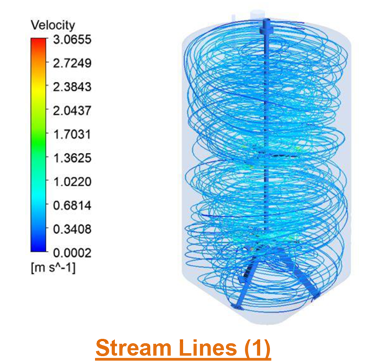
  • Verito’s engineers utilize CFD technology to gain an in-depth understanding of velocity distribution, flow patterns, areas with low velocity (referred to as dead zones, as illustrated in Figures 1, 2 & 3), as well as regions with both low and high shear rates within various mixing system configurations.
  • This enables the testing of multiple system setups and tank agitator designs to achieve optimal performance. Additionally, CFD technology aids Verito in fine-tuning impeller blade designs to strike a balance between power requirements and pumping capacity.


Key Outcomes of CFD-Studies


  • In-depth Information of Flow pattern
  • Areas with the potential of low mixing intensity can be pinpointed and rectified.
  • Availability of crucial process parameters like shear and energy dissipation
  • Evaluation of different design options
  • Shortened project timelines for complex process mixing systems
  • Mitigation of project risks