Long Shaft Paddle Agitator for Biogas Plant

Side Entry Long Shaft Paddle Agitator for Efficient Biogas Mixing

Verito make Side Entry Long Shaft Paddle Agitator is specially designed for Biogas and CBG plants to handle high viscosity, fibrous, and high solids (TS) substrates efficiently.

The agitator operates on a low speed – high torque principle, ensuring gentle yet effective mixing without disturbing biological activity inside the digester.

Widely used in:

  • Primary Digesters
  • Secondary Digesters
  • Digestate Storage Tanks

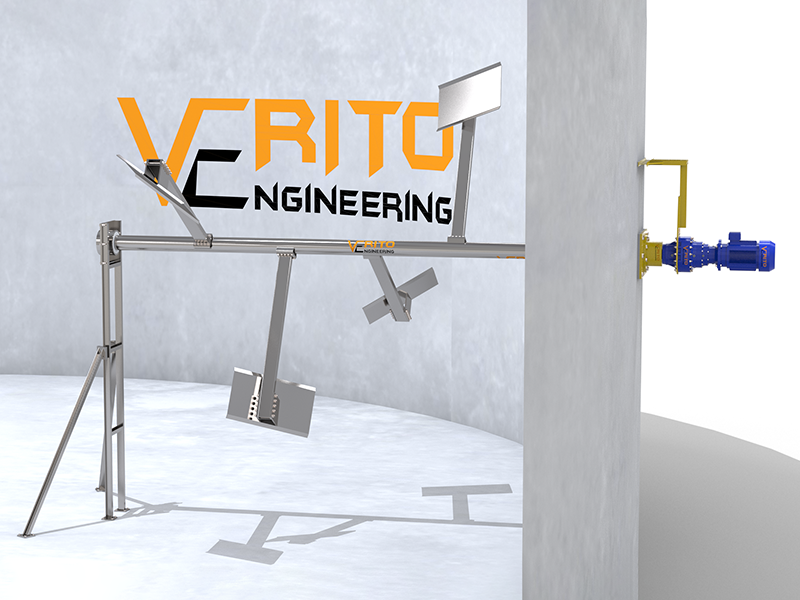
The long shaft with multiple paddles ensures complete top-to-bottom mixing, preventing floating layers and sedimentation.
Design Features


Slow Speed – High Torque Operation

  • Designed for 6–15 RPM operation
  • Ensures efficient mixing of high TS substrates (up to 12–15%)


Long Shaft Construction

  • Suitable for large tank diameters (up to 30 m and above)
  • Shaft length customized


Multi-Paddle Design

  • Four or more inclined paddles
  • Ensures
    • bulk circulation
    • Breaks floating layers
    • Suspends settled solids


Mechanical Sealing System

  • Reliable sealing at tank entry
  • Suitable for biogas applications


External Drive Assembly

  • Motor & gearbox mounted outside the tank
  • Easy access for maintenance
  • No need to empty tank


Heavy Duty Bearings

  • External + internal support bearings
  • Internal guide bearing for shaft stability


Energy Efficient

  • Low RPM reduces power consumption


Technical Specifications
Application Biogas slurry, manure, high viscosity feedstock
Tank Diameter 15 – 30 m
Impeller Paddle Type
Motor 11 – 22 kW
Speed 6 – 15 RPM
Shaft Length 5 – 11 m
Gearbox 3-stage planetary
Material SS / Galvanized / Coated Steel
Standards CE, ATEX, IECEx

Operational Benefits

  • Higher gas yield through uniform mixing
  • Prevents sedimentation & floating layers
  • Improves microbial activity
  • Low energy consumption
  • Easy maintenance without tank emptying
  • Low noise operation
CFD in Mixing Technology
What is CFD ?


  • Computational Fluid Dynamics (CFD) represents an approved approach within the realm of fluid mechanics. Its widespread application is evident in industries such as automotive, aircraft, process, and mixing.
  • The primary objective of CFD is to address fluid flow-related inquiries by leveraging numerical techniques. The governing equations typically revolve around principles like Navier-Stokes, Euler, or potential-based equations.


Flow Simulation at Verito


  • Verito leverages cutting-edge Computational Fluid Dynamics (CFD) technology, alongside laboratory experiments and field trials, to design, scale-up, enhance, or modernize agitators and mixing systems.
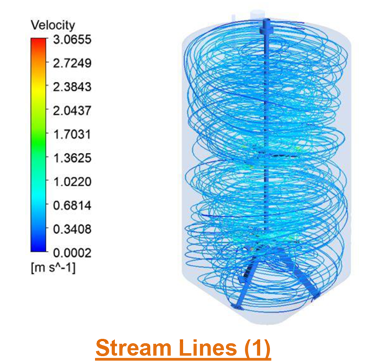
  • Verito’s engineers utilize CFD technology to gain an in-depth understanding of velocity distribution, flow patterns, areas with low velocity (referred to as dead zones, as illustrated in Figures 1, 2 & 3), as well as regions with both low and high shear rates within various mixing system configurations.
  • This enables the testing of multiple system setups and tank agitator designs to achieve optimal performance. Additionally, CFD technology aids Verito in fine-tuning impeller blade designs to strike a balance between power requirements and pumping capacity.


Key Outcomes of CFD-Studies


  • In-depth Information of Flow pattern
  • Areas with the potential of low mixing intensity can be pinpointed and rectified.
  • Availability of crucial process parameters like shear and energy dissipation
  • Evaluation of different design options
  • Shortened project timelines for complex process mixing systems
  • Mitigation of project risks