Velocity Meaning and Core Concept
Dictionary meaning: Velocity is the rate of change of displacement with time, and it
has a direction.
In very simple English: Velocity tells how fast something moves and in which
direction.
'Velocity' in some of the Indian Languages
| Language |
Word or phrase used |
Simple explanation in that language |
What it relates to |
| Hindi |
वेग (Veg) |
वेग मतलब दिशा के साथ गति। कितनी तेजी से और किस दिशा में। |
स्कूल फिजिक्स, रोड यात्रा |
| Marathi |
वेग |
वेग म्हणजे दिशा धरून चालण्याचा वेग. |
शाळेतील विज्ञान, वाहतूक |
| Tamil |
வேகம் (Vēgam) |
திசையுடன் கூடிய நகர்வு வேகம். எவ்வளவு வேகம், எந்த திசை. |
பள்ளி இயற்பியல், பயணம் |
| Kannada |
ವೇಗ (Vēga) |
ದಿಕ್ಕಿನೊಂದಿಗೆ ಇರುವ ಚಲನೆಯ ವೇಗ. |
ಶಾಲಾ ಭೌತಶಾಸ್ತ್ರ, ಸಾರಿಗೆ |
| Bengali |
বেগ (Beg) |
দিকসহ গতি। কত দ্রুত এবং কোন দিকে। |
স্কুল বিজ্ঞান, খেলাধুলা |
| Gujarati |
વેગ (Veg) |
દિશા સાથેની ગતિ. કેટલો ઝડપથી અને કઈ દિશામાં. |
શાળાનું ભૌતિકશાસ્ત્ર |
| Telugu |
వేగం (Vēgam) |
దిశతో కూడిన చలనం. ఎంత వేగంగా, ఏ దిశలో. |
స్కూల్ ఫిజిక్స్, ప్రయాణం |
| Malayalam |
വേഗം (Vēgam) |
ദിശയോടുകൂടിയ ചലനത്തിന്റെ വേഗം. |
സ്കൂൾ ഫിസിക്സ്, യാത്ര |
1) Velocity in Simple Terms
Velocity is a vector quantity, which means it always needs two parts to be complete. The first part
is magnitude, which tells how much displacement happens in a given time. The second part is
direction, which tells the way the motion is happening, such as east, west, upward, downward, or any
other specified direction. If you only say how fast something is moving without mentioning
direction, you are not giving velocity fully, you are giving only speed.
Velocity depends mainly on displacement, time, and direction. Displacement is the straight-line
change in position from the starting point to the ending point, not the total path length. Time is
how long the change takes. Direction tells where the displacement is pointing. For example, moving
50 metres east in 10 seconds gives a different velocity than moving 50 metres west in 10 seconds,
even though the magnitude is the same, because the direction is different.
How to explain velocity to a 14-Year-Old?
Velocity is like giving two pieces of information together:
- How fast you are moving
- In which direction you are moving
Example:
- "I am cycling at 10 km/h" is speed.
- "I am cycling at 10 km/h towards my school" is velocity.
If you go from home to school and then come back home, your distance is big, but your displacement
becomes zero. That is why your average velocity can be zero.
2) Velocity Types and Related Concepts
Speed and Velocity
- Speed: distance per time (scalar, no direction)
- Velocity: displacement per time (vector, direction matters)
Example:
- You walk 100 m in 20 s.
- Speed = 100/20 = 5 m/s
- If your displacement is 100 m east in 20 s,
- Velocity = 5 m/s east
Another, not so relevant example, but for the sake of simplicity -
- Speed is like saying, "I ate 10 samosas per minute."
- Velocity is like saying, "I ate 10 samosas per minute, and I am moving towards the kitchen."
Speed tells how fast. Velocity tells how fast and which direction.
Average Velocity
Meaning: total displacement divided by total time.
If you go somewhere and return to the start, displacement can become zero.
Example:
Home to school and back home: displacement = 0, so average velocity = 0 even though distance is not
zero.
Instantaneous Velocity
Meaning: velocity at a particular moment, like "right now".
Idea using graphs:
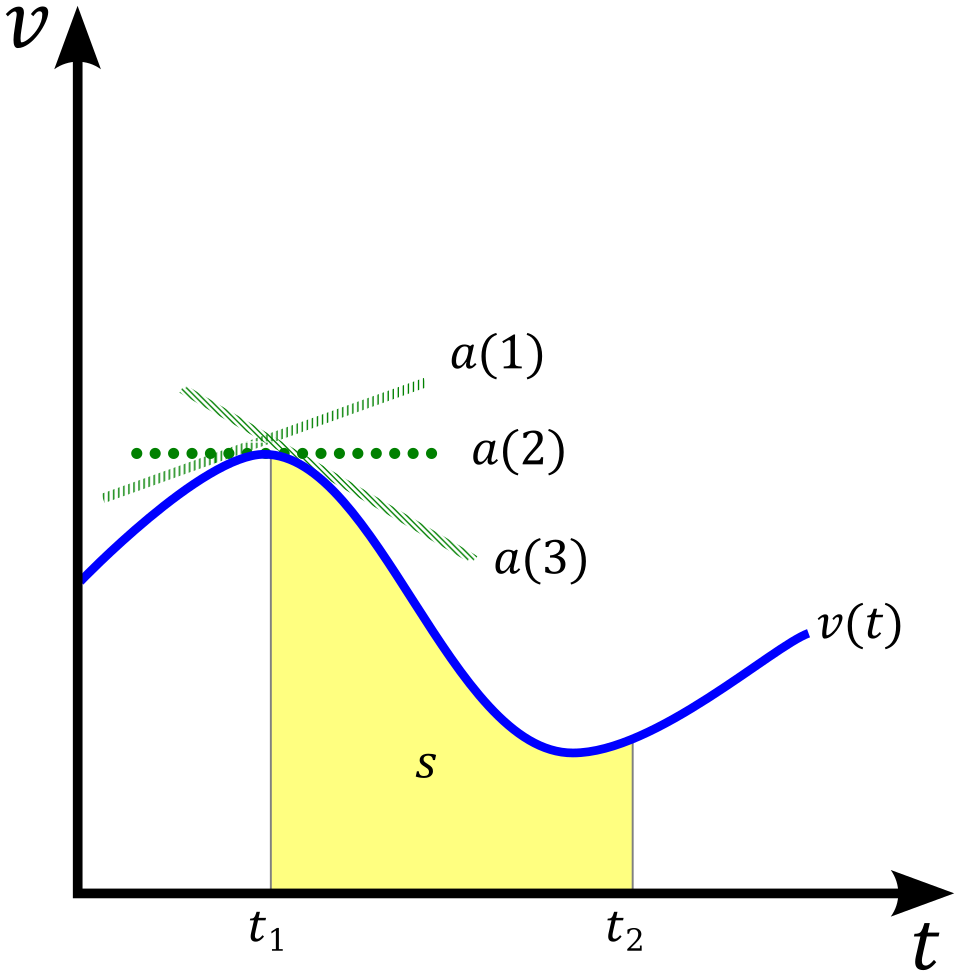
On a displacement-time graph, the slope at a point gives instantaneous velocity.
Uniform and Non-uniform Velocity
- Uniform velocity: magnitude and direction stay constant.
- Non-uniform velocity: magnitude changes, direction changes, or both change.
Example:
- Uniform: a train moving straight at constant speed on a long straight track.
- Non-uniform: a turning bike, or a car that speeds up and slows down in traffic.
Angular Speed and Angular Velocity
- Angular speed: how fast the angle changes, scalar (no direction).
- Angular velocity: how fast the angle changes with direction, vector (along the
axis of rotation).
Example:
A ceiling fan may have the same angular speed, but angular velocity includes the axis direction.
Angular and Linear Velocity
- Linear velocity: straight-line motion (m/s).
- Relation: v = rω
This gives linear speed at a distance r from the center.
Example:
If r = 0.2 m and ω = 10 rad/s, then v = 0.2 × 10 = 2 m/s.
Flow Velocity and Fluid Velocity
Meaning: velocity of a fluid particle at a point.
Used for water in pipes, rivers, air flow, and even blood flow.
Example:
Water flowing through a tap pipe has a flow velocity, which affects pressure loss.
Gas Velocity
Same idea as fluid velocity, often discussed in:
- chimneys
- turbines
- HVAC ducts
- industrial ventilation
Absolute Velocity
Velocity measured relative to a fixed frame, like the ground.
Example:
A bus moving at 20 m/s relative to the road has absolute velocity 20 m/s in that direction.
Friction Velocity (u-star)
Used in turbulence and boundary layer flows, like wind near the ground or river beds.
It is not "velocity due to friction" in daily language. It is a derived fluid mechanics parameter.
Angular Momentum and Angular Velocity
Connection: L = Iω
- L: angular momentum
- I: moment of inertia
- ω: angular velocity
If I is bigger, it is harder to spin fast for the same angular momentum.
Velocity vs Viscosity
- Velocity: motion, unit m/s
- Viscosity: fluid property that resists flow, unit Pa·s
Example:
Honey has high viscosity, so it flows slowly even if you try to make it move fast.
How Velocity Works: Step-by-Step
- Choose a reference point (starting position).
- Measure displacement: final position minus initial position.
- Measure time taken.
- Divide displacement by time.
- Add direction (east, west, upward, clockwise along axis, etc.).
- For changing motion, use graphs: slope of displacement-time graph gives velocity.
Important Formulae With Simple Examples
A) Linear Velocity
Average velocity:
- Δx: change in displacement (m)
- Δt: change in time (s)
Example:
Displacement = 100 m east, time = 20 s
v(avg) = 100/20 = 5 m/s east
Speed:
Example: distance 100 m in 20 s, speed = 5 m/s (no direction)
B) Angular Velocity
- Δθ: change in angle (radians)
- Δt: time (s)
Example:
Wheel turns π radians in 2 s
ω = π/2 rad/s
Angular to linear relation:
C) Flow Velocity in Pipes
- Q: volumetric flow rate (m³/s)
- A: cross-sectional area (m²)
Example:
Q = 0.01 m³/s, A = 0.005 m²
v = 2 m/s
D) Friction Velocity (u-star)
- τ: shear stress (N/m²)
- ρ: density (kg/m³)
Beginner idea: more shear stress or lower density can increase u-star.
Applications and Use Cases (Indian Context)
- Road transport: Car velocity on NH48 matters because direction decides
navigation and arrival side.
- Railways: Train velocity relative to ground vs relative to another train
changes what passengers observe.
- Cricket: Ball velocity plus direction changes with swing and spin, so the ball
can move sideways while going forward.
- Rivers and flooding: Flow velocity in Ganga or Brahmaputra affects erosion and
flood risk.
- Pipes in homes and industries: Water flow velocity affects pressure loss and
pumping needs.
- Air and wind: Monsoon wind velocity in coastal areas like Chennai and Mumbai
matters for weather and safety.
- Engineering and exams: CBSE Class 9 to 11, JEE, NEET focus on velocity, graphs,
and numericals.
- Factories and HVAC: Gas velocity in ducts and chimneys affects ventilation and
removal of fumes.
Specialised cases:
Agitators (mixing tanks and reactors)
- Angular velocity: rpm sets impeller rotation rate.
- Linear velocity at blade tip: bigger impeller at same rpm gives higher tip
speed, stronger circulation.
- Uniform vs non-uniform velocity: low-velocity zones cause settling, poor
blending, dead zones.
- Direction of velocity: axial flow improves top to bottom mixing, radial flow
gives higher shear and dispersion.
- Relative velocity: bubble or particle velocity relative to liquid affects gas
dispersion and solid suspension.
- Instantaneous velocity: local peaks near blades can cause shear damage in
polymers, flocs, or delicate products.
Chemical dosing pumps
- Flow velocity in lines: velocity = Q/A guides tubing size for stable dosing and
manageable pressure loss.
- Gas velocity and air pockets: low flow velocities can trap air, cause loss of
prime, erratic dosing.
- Instantaneous velocity from pulsation: stroke pulses create velocity spikes,
affects analyzer stability and control.
- Absolute vs relative velocity at injection: injection direction and main-line
velocity decide mixing quality at the quill.
- Non-uniform velocity in main pipe: injecting into low-velocity zones increases
wall wetting, scaling, and corrosion risk.
- Friction effects: higher line velocity increases friction losses, impacts
discharge pressure and valve performance.