
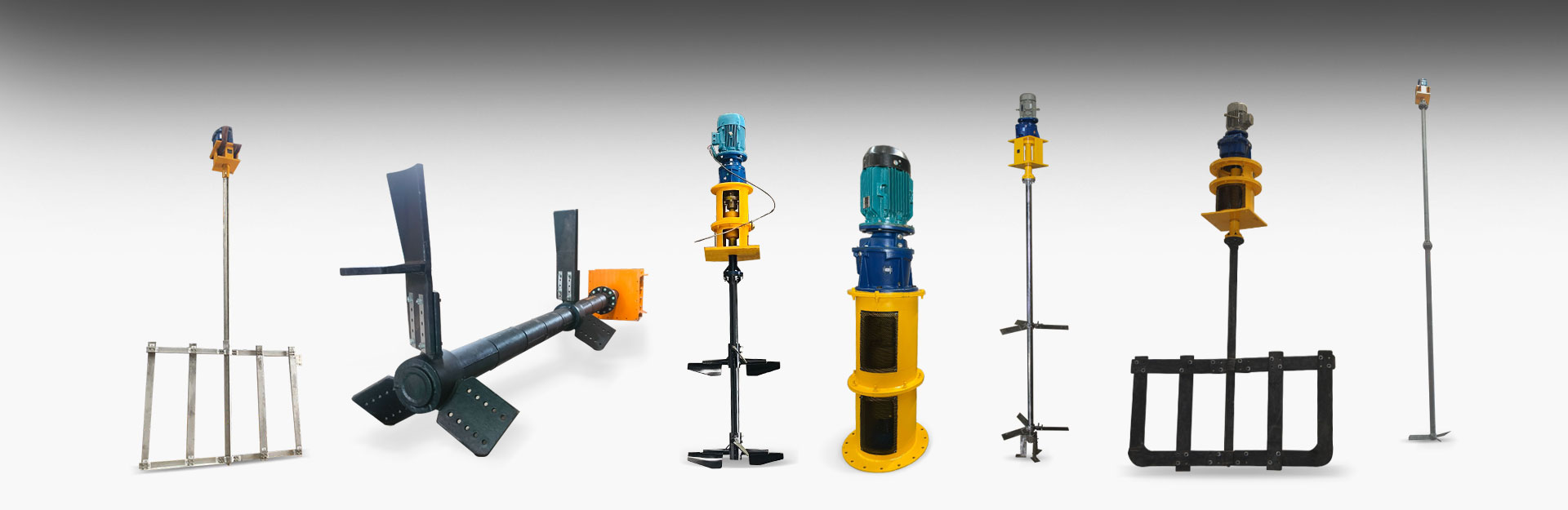
Industrial agitators are mechanical devices that mix, blend, or stir materials inside tanks and vessels. They are essential in processes where consistent mixing determines product quality. These agitators handle 6 core tasks: homogenizing liquids, suspending solids, dispersing gases, emulsifying immiscible liquids, promoting chemical reactions, and maintaining uniform temperature. Each type handles specific materials and mixing conditions.
Industrial agitators serve sectors including chemicals, pharmaceuticals, food processing, water treatment, oil refining, and cosmetics. Choosing the right type increases efficiency, reduces energy use, and improves product consistency.
Parts of an Industrial Agitator
An industrial agitator has 3 primary components: the motor, shaft, and impeller.
The motor component drives the assembly, producing the torque needed to control flow and shear in the media. Power requirements depend on factors like viscosity, specific gravity, solid content, impeller speed, and impeller diameter.
The shaft component transmits torque from the motor to the impeller. Manufacturers construct it using couplings, end caps, and seals to eliminate material buildup and ensure smooth operation.
The impeller component determines the flow pattern, efficiency, and mixing intensity. It transfers energy directly to the material being mixed. Impellers fall into 2 categories:
- Open-blade impellers: blades connect directly to the shaft, making cleaning easier
- Disc-type impellers: a disc carries attached blades, producing uniform radial flow — used primarily in gas dispersion
Flow Patterns in Industrial Agitators
Impeller design creates 3 primary flow patterns inside a mixing vessel.
Axial flow moves fluid parallel to the shaft — up or down through the tank. Propeller and helical agitators primarily produce this pattern. Axial flow is effective for blending and solid suspension.
Radial flow moves fluid outward from the shaft toward the tank walls. Turbine agitators produce strong radial flow. Radial flow is effective for gas dispersion and high-shear mixing.
Tangential flow moves fluid in a circular path around the shaft. Paddle and anchor agitators produce this pattern. Tangential flow suits viscous, heat-sensitive materials where gentle mixing is required.
12 Types of Industrial Agitators
There are 12 main types of industrial agitators. Each type suits specific viscosity ranges, tank configurations, and process goals.
1. Paddle Agitators
Paddle agitators have flat blades mounted on a central rotating shaft. These blades reach toward the tank wall and produce a low-shear, tangential flow pattern. Paddle agitators operate at low speeds, generating laminar mixing without over-stressing the material.
They work best for low to moderate viscosity liquids. Applications include wastewater treatment, chemical blending, food processing, crystallization, and heat transfer operations. Secondary blades can be added to paddle blades for more viscous materials.
2. Anchor Agitators
Anchor agitators feature U-shaped blades that follow the contour of the tank wall. These blades scrape along the vessel walls, preventing material buildup and ensuring uniform heat distribution. Anchor agitators produce tangential flow by default. Adding angled blades to the horizontal supports introduces axial flow for more demanding tasks.
They are ideal for high-viscosity fluids. Applications include paints, adhesives, cosmetics, pharmaceutical formulations, and food pastes. These agitators pair effectively with heating or cooling jackets.
3. Turbine Agitators
Turbine agitators use multiple blades mounted radially on a central shaft. They produce high radial flow and strong shear forces. Turbine agitators balance the properties of both propeller and paddle agitators. They handle a wider viscosity range than propeller agitators and can process liquid, gas, and solid interactions.
Turbine agitators fall into 5 sub-types: straight-blade, pitched-blade, Rushton-blade, Smith-blade, and curved-back turbine impellers.
Applications include chemical processing, pharmaceutical reactors, fermenter tanks, and petrochemical industries.
4. Propeller Agitators
Propeller agitators resemble marine propellers and carry 2 to 4 blades on a central shaft. They operate at high speeds and produce axial flow by drawing fluid toward the impeller and displacing it longitudinally. Tapered blades minimize centrifugal force and maximize axial movement.
They are ideal for low-viscosity liquids. Applications include beverage manufacturing, solvent mixing, fermentation processes, and laboratory processing. Propeller agitators are energy-efficient for quick blending tasks in small to medium tanks.
5. Helical Agitators
Helical agitators carry spiral blades that create a combined horizontal and vertical motion. This motion moves materials in a screw-like path, generating strong top-to-bottom turnover throughout the tank. Helical agitators minimize dead zones and reduce energy consumption compared to other high-viscosity options.
They excel with thick slurries and viscous materials. Applications include mining, pulp and paper, oil processing, heavy-duty chemical blending, and adhesive production. These agitators prevent sedimentation and clogging in difficult materials.
6. Helical Ribbon Agitators
Helical ribbon agitators have impeller blades shaped like a helical ribbon fixed to the shaft. They produce axial flow along the full length of the tank, moving fluid more thoroughly than standard anchor agitators. Helical ribbon agitators carry a larger fluid contact area, making them highly effective for viscous materials.
A variant, the double helical ribbon agitator, uses 2 counter-rotating blades to enhance axial circulation and mixing capacity. Applications include high-viscosity laminar flow processes, heat transfer operations, and blending shear-sensitive media.
7. Side-Entry Agitators
Side-entry agitators mount on the side wall of a tank rather than the top. This positioning suits large storage tanks where top-entry mounting is impractical or structurally difficult. Side-entry agitators require lower power for the same mixing result in large volumes and allow maintenance without emptying the tank.
Applications include oil refineries, biogas plants, large chemical storage tanks, and blending operations requiring continuous production. These agitators are cost-effective for large-scale industrial use.
8. Magnetic Agitators
Magnetic agitators use a magnetic coupling to drive the mixing blades without direct mechanical contact between the motor and the vessel interior. This design eliminates the need for mechanical seals entirely. Magnetic agitators are best suited for low-volume, low-viscosity fluids.
Applications include pharmaceutical manufacturing, biotech reactors, laboratory testing, chemical sampling, and research and development. Their sealed design prevents contamination when mixing sensitive or hazardous materials.
9. Ribbon Agitators (Ribbon Blenders)
Ribbon agitators carry helical ribbons that move materials in opposite directions simultaneously within a mixing chamber. This counter-directional motion ensures thorough blending of solid and semi-solid materials. Ribbon agitators achieve high mixing efficiency with relatively low energy consumption.
Applications include dry powder blending, granule mixing, food seasoning, pharmaceutical powders, and industrial chemical processing. They handle both dry and wet ingredients across a single cycle.
10. Jet Agitators
Jet agitators use high-velocity liquid jets to mix vessel contents without any internal moving parts. The jet stream creates turbulence throughout the tank. Jet agitators are easy to clean and maintain because they have no mechanical components inside the vessel.
Applications include dairy and beverage processing, clean-in-place (CIP) systems, bioreactors, and hygienic or sterile processing environments. Jet agitation provides contamination-free mixing where mechanical contact is not acceptable.
11. High-Speed Agitators
High-speed agitators operate at high rotational speeds to generate intense turbulence and shear forces throughout the liquid. This turbulence rapidly breaks down particles, disperses immiscible components, and creates uniform emulsions. High-speed agitators deliver fast results in short cycle times.
Applications include emulsification, powder dispersion, paint production, coatings, and cosmetics manufacturing. These agitators reduce processing time in batch operations.
12. Static Agitators (Inline Mixers)
Static agitators are fixed structures installed inside a pipe. They have no moving parts. Mixing occurs as fluid flows through the stationary elements, which create turbulence using the pressure of the flowing material. Static agitators are low-cost and require minimal maintenance.
Applications include water treatment, oil blending, inline chemical dosing, continuous chemical processing, and oil pipeline operations. Static agitators suit continuous production systems where inline mixing is required.
How to Choose the Right Industrial Agitator
Choosing the right agitator requires evaluating 4 main factors.
First, assess fluid viscosity. Low-viscosity liquids suit propeller or turbine agitators. High-viscosity materials require anchor, helical, or ribbon agitators. Shear-sensitive materials need gentle designs like helical ribbon or screw impeller agitators.
Secondly, define the process requirement. Determine the function — blending, dissolving, gas dispersion, heat transfer, emulsification, or chemical reaction. Match the agitator’s flow pattern (axial, radial, or tangential) to the process goal.
Thirdly, evaluate tank size and configuration. Large tanks suit side-entry or top-entry designs with appropriate shaft lengths. Small or pressure-controlled vessels suit magnetic or jet agitators.
Finally, consider material compatibility. Identify corrosive or hazardous chemical properties. Select construction materials such as stainless steel, Hastelloy, or coated options to suit the media. For sterile environments, choose sealed designs like magnetic or jet agitators.
Comparison of Industrial Agitator Types
| Agitator Type | Viscosity Range | Flow Pattern | Key Applications |
|---|---|---|---|
| Paddle | Low to medium | Tangential | Water treatment, food processing |
| Anchor | High | Tangential + axial | Paints, cosmetics, pharmaceuticals |
| Turbine | Medium to high | Radial | Chemical reactors, fermentation |
| Propeller | Low | Axial | Beverages, solvents, lab mixing |
| Helical | High | Axial + vertical | Mining, pulp, oil |
| Helical Ribbon | Very high | Axial | Heat transfer, viscous laminar flow |
| Side-Entry | Low to medium | Axial | Oil tanks, biogas, large storage |
| Magnetic | Low | Varies | Pharma, biotech, lab |
| Ribbon Blender | Solid/paste | Counter-directional | Powders, granules, food |
| Jet | Low | Turbulent | Dairy, CIP systems, bioreactors |
| High-Speed | Low to medium | High shear | Emulsification, paints, coatings |
| Static | Low to medium | Turbulent | Inline dosing, pipelines |
Understanding the 12 types of industrial agitators and their flow patterns, viscosity ranges, and applications allows industries to match the right equipment to each process. The right agitator improves mixing consistency, reduces energy consumption, and extends equipment service life.
At Verito Engineering, we specialize in manufacturing high-quality agitators for diverse industrial requirements. Our range covers mineral slurry agitators, chemical reactor agitators, heavy-duty agitators, high-speed agitators, and flocculators — built for reliability, precision, and demanding mixing processes. Contact Verito Engineering to find the right agitator for your operation.
FAQs
Q1. Can paddle agitators handle solids suspended in liquid?
Paddle agitators handle light solid suspensions in low to moderate viscosity liquids. Paddle agitators are not suited for dense or heavy solids: turbine or helical agitators are the better choice for those.
Q2. Why do anchor agitators perform better than paddle agitators in heated vessels?
Anchor agitators scrape continuously along the tank wall, removing the stagnant fluid layer and replacing it with cooler bulk material. Anchor agitators distribute heat more uniformly across high-viscosity batches because of this direct wall contact.
Q3. Which turbine impeller sub-type is best for gas dispersion?
The Rushton-blade turbine impeller is best for gas dispersion because its disc-mounted flat blades produce strong radial flow that breaks up and distributes gas bubbles evenly through the liquid. Straight-blade and curved-back turbines suit liquid-liquid mixing instead.
Q4. At what viscosity do propeller agitators stop being effective?
Propeller agitators lose effectiveness above approximately 2,000 to 3,000 centipoise (cP) because the axial flow they produce cannot overcome higher fluid resistance. Turbine, helical, or anchor agitators are more appropriate above this range.
Q5. How do helical agitators prevent sedimentation in mining slurries?
Helical agitators generate continuous top-to-bottom turnover through a screw-like spiral blade path, keeping dense particles moving before they settle. Helical agitators also sweep along the tank floor, dislodging any material that begins to accumulate.
Q6. What is the difference between a helical agitator and a helical ribbon agitator?
A helical agitator uses solid spiral blades and suits thick slurries, while a helical ribbon agitator uses thin ribbon-shaped blades with a larger fluid contact area and suits very high-viscosity laminar flow applications. Helical ribbon agitators are gentler on shear-sensitive media because of their wider blade surface and slower axial movement.
Q7. Can side-entry agitators be used in tanks with floating roofs?
Side-entry agitators are fully compatible with floating roof tanks because their side-wall mounting position does not interfere with the roof mechanism. Side-entry agitators maintain homogeneous blending and prevent sedimentation without any mechanical conflict with the floating roof structure.
Q8. What makes magnetic agitators suitable for mixing hazardous materials?
Magnetic agitators use a sealed vessel with no shaft penetration through the vessel wall, eliminating any opening through which hazardous vapors or reactive chemicals could escape. Magnetic agitators remove the need for mechanical shaft seals, which are the most common leak point in conventional agitator designs.
Q9. Can ribbon agitators process wet and dry ingredients in the same batch?
Ribbon agitators process wet and dry ingredients together in a single cycle because the counter-directional ribbon motion creates thorough overlap of all components throughout the mixing chamber. Ribbon agitators ensure uniform distribution without dry pockets or liquid pooling at any point.
Q10. Why do jet agitators not require mechanical seals?
Jet agitators mix vessel contents through high-velocity liquid jets from nozzles mounted on the vessel wall or floor, with no rotating shaft or moving parts inside the vessel. Jet agitators require no mechanical seals because no mechanical component penetrates the vessel wall through a rotating interface.
Q11. What RPM range do high-speed agitators operate at?
High-speed agitators typically operate between 1,000 and 10,000 revolutions per minute (RPM), depending on the impeller design and application. High-speed agitators produce greater shear forces at higher RPM, which is necessary to break immiscible liquid droplets down to a stable, micron-level size during emulsification.
Q12. Do static agitators work for high-viscosity fluids in pipelines?
Static agitators are not effective for high-viscosity fluids because their mixing performance depends entirely on the pressure and velocity of the flowing material passing through the fixed elements. Static agitators perform best with low to medium viscosity fluids in continuous, pressurized systems such as water treatment lines and inline chemical dosing.