
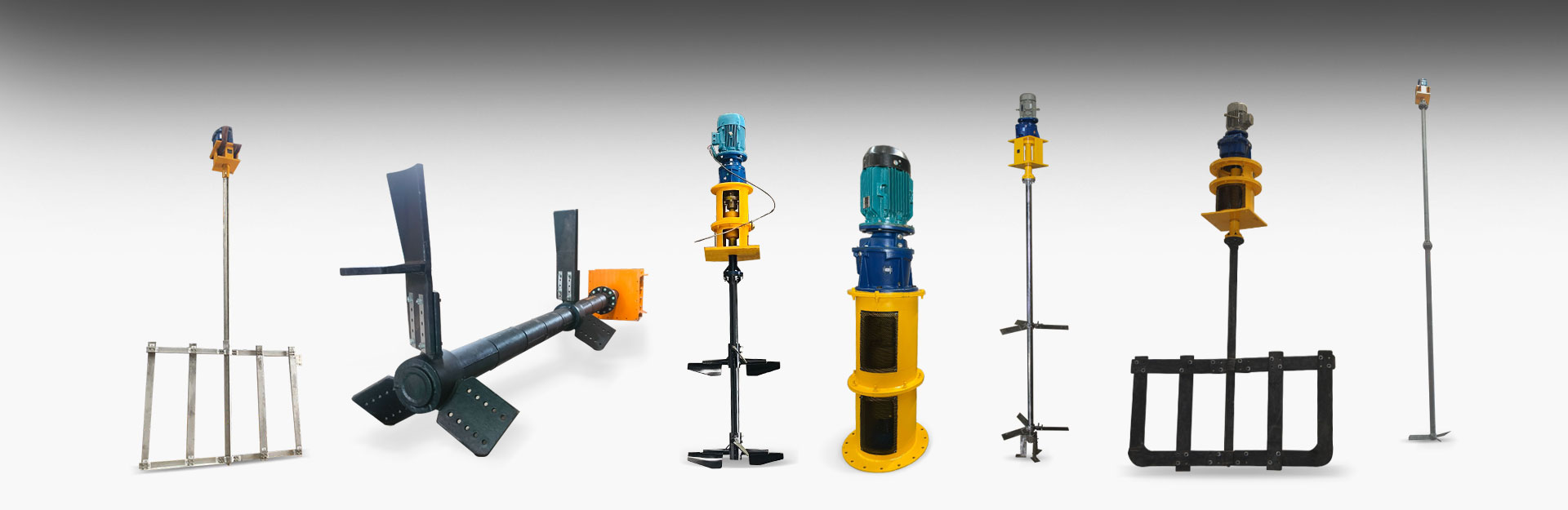
Industrial agitators are mechanical devices used to mix, blend, suspend, or homogenize materials in tanks or reactors. These materials include liquids, solids, and gases. Industries such as chemical processing, pharmaceuticals, food and beverage, water treatment, and paints use them widely. Industrial agitators ensure uniform mixing, improve product consistency, and boost operational efficiency.
Note on terminology: The word “mixing” refers to the random arrangement of 2 or more substances. “Agitation,” on the other hand, refers to the formation of a specific flow pattern in a liquid. Both terms are often used together but describe different actions.
Key Components of an Industrial Agitator
An industrial agitator has 4 core components. Each component plays a specific role in the mixing process.
1. Motor – Powers the Mixing Process
The motor converts electrical or pneumatic energy into mechanical motion. The motor drives the rotational movement of the shaft and impeller. Motors are selected based on the required torque, speed (RPM), and hazard classification — for example, flameproof motors for explosive zones.
2. Shaft – Transmits Power
The shaft connects the motor to the impeller. The shaft transmits rotational energy down to the impeller. Stainless steel or Hastelloy are the typical shaft materials because of their durability and corrosion resistance. Proper shaft alignment is critical to avoid vibration and mechanical wear.
3. Impeller – Creates Flow Patterns
The impeller contacts the materials being mixed directly. Its design dictates the flow pattern and mixing intensity. There are 3 main impeller categories:
- Axial Flow Impeller – moves fluids vertically, ideal for low-viscosity liquids.
- Radial Flow Impeller — pushes material outward, suitable for high-shear applications.
- Anchor or Paddle Impellers — used for viscous or non-Newtonian fluids.
4. Mixing Tank – Holds the Materials
The tank contains the materials being mixed. The tank may include baffles (vertical plates) that prevent vortex formation and enhance mixing. Tank geometry — specifically the height-to-diameter ratio — plays a major role in mixing performance.
5 Types of Industrial Agitator Impeller Blade Shapes
The impeller blade shape determines which fluid viscosity the agitator handles. There are 5 common blade shapes used in industrial agitators.
- Straight Blade – the impeller blade is straight and contains 1 to 8 blades. Straight blade agitators are used for mixing low-viscosity liquids.
- Straight Blade Turbine – the blade is fan-shaped with 2 to 4 blades. Straight blade turbine agitators are suitable for medium-viscosity liquids.
- Propeller Blade – the blade has 3 blades arranged in a helical shape. Propeller blade agitators mix low-viscosity liquids.
- Anchor Blade – the blade is anchor-shaped with 2 to 4 blades. Anchor blade agitators handle high-viscosity liquids.
- Ribbon Blade – the blade is ribbon-shaped with 1 to 4 blades. Ribbon blade agitators are suited for high-viscosity liquids.
Types of Industrial Agitators and Mixers
Industrial agitators differ in their characteristics depending on the production process. There are 3 main types.
Industrial Rotor Mixers
Industrial rotor mixers are the most common type. In these mixers, a rotor made up of blades rotates and pushes the material until it reaches the desired uniformity. Rotor mixers are used across most standard-viscosity mixing applications.
Turbine Mixers
Turbine mixers are more robust than rotor mixers. They offer a wider selection of rotors, sealing systems, and motor ranges. Turbine mixers handle high-viscosity or tight-tolerance operations. They are generally mounted vertically and can align with the center of the container.
High Viscosity Mixers
High viscosity mixers operate at low speed and high torque to rotate larger impellers. High viscosity mixers tolerate greater force relative to the tank wall. They use 2 rotor types:
- Anchor-shaped rotors — effective in reducing the size of powder particles and droplets rapidly, facilitating dispersion.
- Helical rotors — improve efficiency, especially in axial flow applications.
How Do Industrial Agitators Work?
An industrial agitator works by transferring mechanical energy from the motor to the impeller. The impeller then stirs the fluid inside the tank to create the desired flow patterns. There are 5 steps in the process.
- The motor generates rotational energy.
- The shaft transfers this rotational energy to the impeller.
- The impeller moves the fluid or solid inside the tank.
- The resulting flow patterns ensure even distribution, blending, or suspension.
- Baffles inside the tank prevent vortex formation and maintain consistent flow.
3 Common Mixing Actions
Industrial agitators produce 3 mixing actions depending on the impeller design.
- Axial Mixing — promotes vertical circulation, ideal for blending liquids.
- Radial Mixing — generates high shear for breaking solids or dispersing viscous materials.
- Tangential Mixing — induces a swirling flow for uniform consistency.
Factors That Influence Mixing Efficiency
There are 5 main factors that influence mixing efficiency in industrial agitators.
| Factor | Description |
|---|---|
| Impeller Design | Determines flow type, turbulence, and shear force. Axial impellers improve blending; radial impellers increase shear. |
| Rotation Speed (RPM) | Higher speeds increase turbulence but may consume more power or cause foaming. |
| Tank Design | Baffles, tank shape, and volume all impact fluid dynamics. A height-to-diameter ratio of 1:1 is standard for most applications. |
| Viscosity of Materials | High-viscosity fluids require larger or slower-turning impellers such as anchor or ribbon blades. |
| Reynolds Number (Re) | Indicates whether the mixing is laminar or turbulent. Re below 10 = laminar; Re above 10,000 = turbulent. |
Applications of Industrial Agitators
Industrial agitators are used across 6 major industries.
1. Chemical Processing
Industrial agitators blend reactants, maintain uniform temperature, and ensure complete reactions. Chemical processing operations include pH control, homogenizing immiscible fluids, and suspending solids.
2. Pharmaceuticals
Industrial agitators dissolve active ingredients, suspend particles, and prepare syrups or creams. Pharmaceutical applications include the production of ophthalmic solutions, vaccines, ointments, deodorants, shampoos, and toothpaste.
3. Petrochemical Industry
Industrial agitators in the petrochemical sector handle production of oil, gas, and their derivatives. Specific petrochemical operations include homogenizing crude oil with water, controlling the flow of drilling fluids, absorbing carbon dioxide from natural gas, suspending iodine in storage tanks, and controlling pH.
4. Food and Beverage
Industrial agitators mix sauces, batters, dairy, and beverages for consistent texture and taste. Food applications also include the production of pasta, edible oils, and flavor emulsions.
5. Water and Wastewater Treatment
Industrial agitators disperse chemicals, prevent sedimentation, and aid biological treatment. Water treatment uses large rectangular tanks with considerable depth to promote mixing. Applications also include drinking water production and the removal of pathogens, contaminants, salt, and dissolved solids.
6. Paints and Coatings
Industrial agitators blend pigments and maintain emulsion stability. Paints and coatings require consistent agitation to prevent settling of heavy pigment particles.
Common Failures in Industrial Agitators
Industrial agitators require regular maintenance to prevent the 4 most common failure modes.
- Inefficient Agitation or Mixing — caused by a change in agitator speed, a mismatch in impeller position, or the agitator operating above its maximum load capacity. Inefficient agitation means substances are not properly homogenized.
- Leaks and Spills — indicate faulty seals or poor positioning of containers. Leaks and spills require immediate inspection of all seal components.
- Abnormal Vibration — signals an unbalanced impeller or unevenness in the asset. Abnormal vibration accelerates wear on bearings and shafts if left unaddressed.
- Motor Overheating — occurs when the motor operates above its rated thermal load. Motor overheating can result from incorrect viscosity settings or blocked ventilation.
Industrial Agitator vs. Washing Machine Agitator: Similarities and Differences
Industrial agitators and washing machine agitators share the same fundamental principle: a rotating impeller creates fluid motion inside a tank. They differ significantly in scale, purpose, construction, and control.
What They Have in Common
- Both use a motor-driven shaft and impeller inside a tank.
- Both create directional fluid flow — axial or tangential — to move and distribute contents.
- Both rely on rotational speed and impeller geometry to control mixing intensity.
Key Differences
| Attribute | Industrial Agitator | Washing Machine Agitator |
|---|---|---|
| Purpose | Mixing, blending, suspending, or homogenizing industrial materials | Agitating fabric and water to loosen dirt from clothing |
| Scale | Tank volumes range from 10 litres to 100,000+ litres | Drum volumes typically range from 40 to 120 litres |
| Materials Handled | Chemicals, pharmaceuticals, food, slurries, wastewater | Water, detergent, and fabric |
| Impeller Types | 5+ blade types selected by viscosity and flow requirement | 1 fixed agitator post or impeller plate (no selection) |
| Speed Control | Variable RPM, often PLC-driven or computer-controlled | Fixed RPM cycles defined by wash programme |
| Construction | Stainless steel, Hastelloy, ATEX-rated components | Plastic or light aluminium; no chemical-resistance requirement |
| Maintenance Complexity | Requires periodic inspection of seals, bearings, shafts, motors | Minimal — belt, pump, or agitator post replacement only |
| Operating Environment | Industrial plant, hazardous zones, outdoor tanks | Domestic laundry room |
In short: a washing machine agitator performs one task — cleaning fabric — at low power. An industrial agitator performs precise chemical or physical operations at high power, in demanding environments, across dozens of industries.
Advantages of Using Industrial Agitators
Using an industrial agitator delivers 5 core advantages.
- Improved Product Quality — achieves uniformity and prevents settling or clumping.
- Increased Efficiency — reduces batch time and energy waste.
- Versatility — adaptable to fluids with various viscosities and flow behaviors.
- Scalability — suitable for lab, pilot, and full-scale production.
- Reliability — built for continuous, high-load operation in demanding environments.
Maintenance Tips for Optimal Agitator Performance
Proper maintenance ensures long-term reliability and reduces downtime. There are 5 maintenance tasks to schedule.
| Task | Frequency |
|---|---|
| Inspect seals, bearings, and shafts | Monthly |
| Check motor alignment and mounting | Quarterly |
| Clean impeller and tank surfaces | After every use |
| Lubricate moving parts | As per OEM schedule |
| Replace worn components (seals, impellers) | As needed |
Choosing the Right Agitator for Your Process
Choosing the right industrial agitator requires evaluating 5 key criteria.
- Assess material properties – viscosity, density, and abrasiveness determine the impeller blade shape needed.
- Measure tank dimensions and geometry – height-to-diameter ratio affects flow patterns directly.
- Define the mixing goal – blending, dispersion, or heat transfer each require different impeller types.
- Confirm regulatory compliance – FDA, GMP (Good Manufacturing Practice), and ATEX requirements apply in pharmaceutical and hazardous environments.
- Identify customization needs – coatings, sanitary finish, and variable speed control are options for specialized applications.
Verito Engineering Pvt. Ltd. is a trusted manufacturer of industrial agitators. Verito Engineering delivers tailored mixing solutions across industries. With a focus on engineering precision, durability, and compliance, Verito’s agitators meet the most stringent performance standards. Explore Verito’s full range of industrial agitators or speak to a technical expert for application-specific guidance.
Talk to our agitator specialists today: [email protected] | +91 76005 52286
Explore our agitators: https://www.veritoengineering.com/agitator.php
FAQs
1. What is the working principle of an industrial agitator?
In an industrial agitator, the motor generates rotational energy. The shaft carries rotational energy to the impeller. The impeller converts rotational energy into fluid motion inside the tank: axial, radial, or tangential.
2. What does an impeller do inside the tank?
Impeller pushes fluid in a specific direction. Axial impellers push fluid vertically. Radial impellers push fluid outward toward the tank wall.
3. How does rotational speed affect mixing?
Higher speed increases turbulence and reduces mixing time. Lower speed increases torque and suits high-viscosity fluids.
4. What role do baffles play?
Baffles break circular vortex motion and redirect fluid into vertical flow. Without baffles, the fluid spins in place and mixing efficiency drops.
5. What is the Reynolds Number in agitator operation?
Reynolds number (Re) indicates flow type. Re below 10 means laminar flow and poor mixing. Re above 10,000 means turbulent flow and thorough mixing.
6. How does viscosity change the way an agitator works?
High-viscosity fluids need larger impellers, lower RPM, and higher torque. Low-viscosity fluids need smaller, faster impellers.
7. How does axial flow differ from radial flow?
Axial flow moves fluid up and down along the shaft and is best for blending. Radial flow moves fluid outward toward the tank wall and is best for high-shear dispersion.
8. What happens if the impeller is positioned incorrectly?
Incorrectly positioned impeller creates dead zones where fluid settles in an unmixed state. The standard position is one-third of the liquid height from the tank bottom.
9. How does tank geometry affect agitator performance?
A tall, narrow tank promotes axial flow. A wide, shallow tank favors radial flow. A height-to-diameter ratio of 1:1 is the standard starting point.
10. Can an agitator work without a motor?
No. The motor is the only energy source in an agitator. Without it, the shaft and impeller remain stationary.